Overview
What is Counter-Trend Trading Strategy?
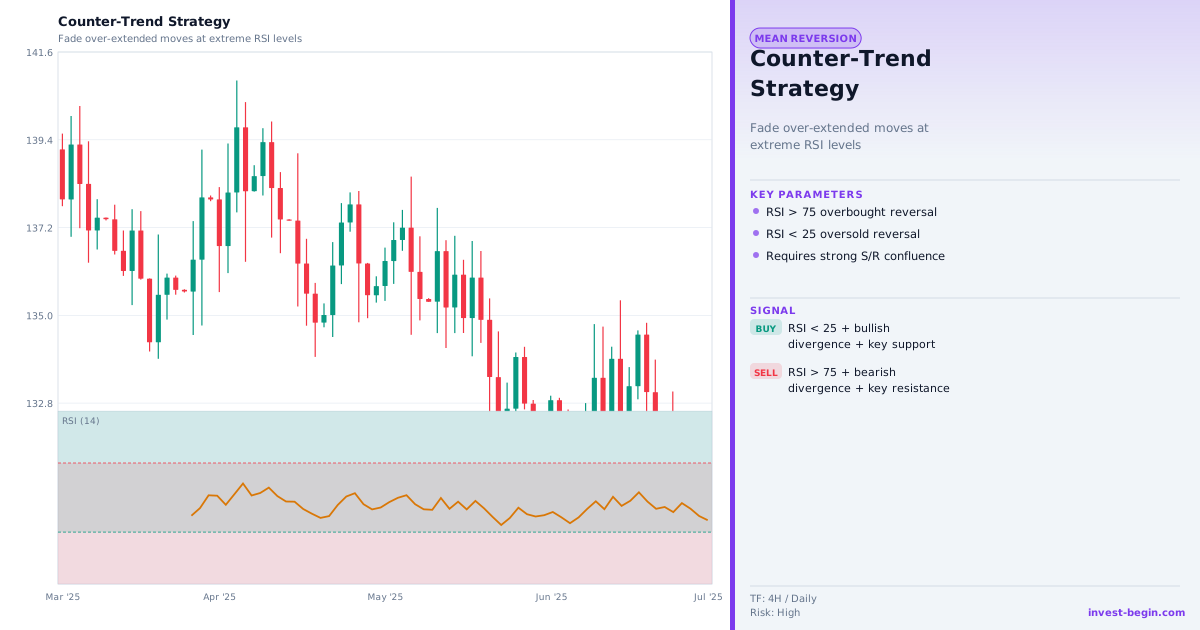
Counter-trend trading is the practice of taking positions against the prevailing trend — buying when price has fallen significantly and appears oversold, or selling when price has risen sharply and appears overbought. It is the conceptual opposite of trend-following, and while it can be extremely profitable, it carries higher inherent risk because you are deliberately fighting the established direction of price.
The strategy's edge comes from "reversion to the mean" dynamics: no price move lasts forever, and extreme moves are statistically likely to correct. The challenge is distinguishing a genuine, high-probability reversal setup from a stock or asset that is in free-fall or in an unstoppable bull run. This distinction is what separates profitable counter-trend traders from those who repeatedly "catch falling knives."
Key tools for counter-trend trading include: oscillators in extreme territory (RSI below 20 or above 80 on a higher timeframe), price trading multiple standard deviations outside Bollinger Bands, bullish or bearish divergence between price and momentum indicators (RSI, MACD, or Stochastic), candlestick reversal patterns at key support/resistance levels (pin bars, engulfing candles), and volume climaxes (a sudden surge in volume after a prolonged trend often marks exhaustion).
Risk management is especially critical in counter-trend strategies. Since you are entering against momentum, the probability of being wrong initially is higher than with trend-following. Position sizing should be conservative (typically 0.5%–1% of capital per trade), and stops must be defined and respected. Many professionals use a scaled-entry approach: taking a partial position at the first reversal signal and adding only if price confirms the reversal.
The most successful counter-trend traders combine strict entry criteria (requiring multiple confluences), accept that they will miss some reversals (better to miss a trade than to be early), and exit quickly if the trade does not move in the expected direction within a defined time period.