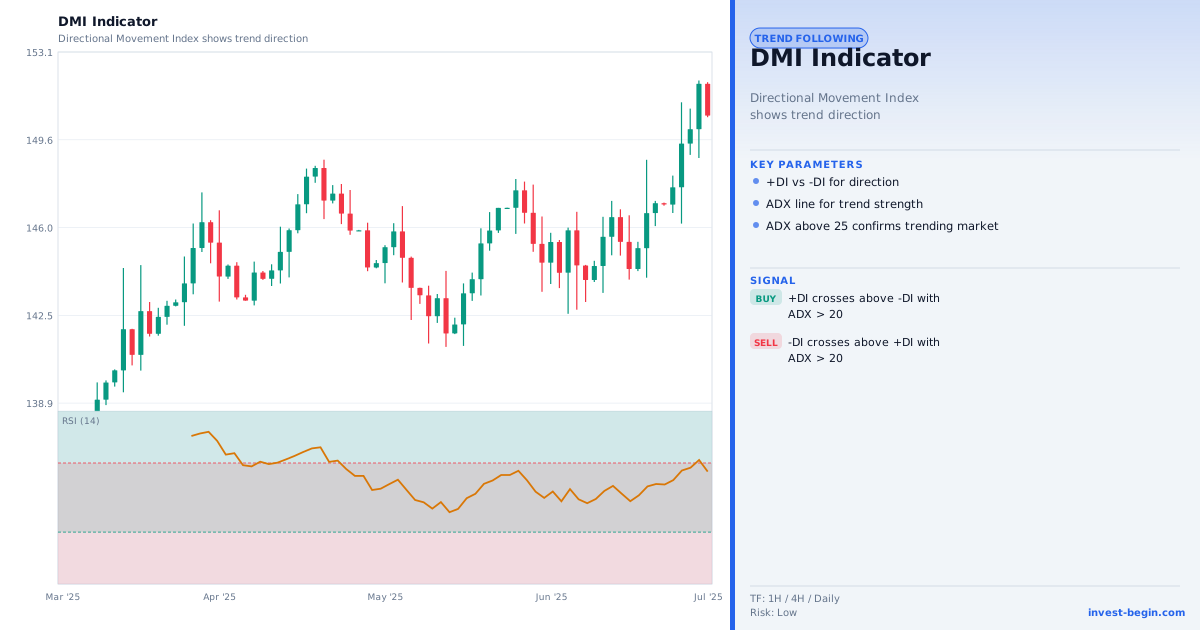
Overview
What is Directional Movement Index (DMI)?
The Directional Movement Index (DMI) was developed by J. Welles Wilder Jr. and introduced in his 1978 book "New Concepts in Technical Trading Systems" — the same work that gave us the RSI and ATR. While ADX (which is derived from DMI) measures trend strength, the DMI itself focuses specifically on trend direction through two component lines: +DI (Positive Directional Indicator) and −DI (Negative Directional Indicator).
+DI measures upward directional movement: the portion of each bar's range that represents new ground covered above the prior bar's high. −DI measures downward directional movement: the portion that covers new ground below the prior bar's low. Both are smoothed over a 14-period window (by default) and expressed as percentages of the Average True Range, making them comparable across different instruments.
The primary trading signal is the +DI/−DI crossover: when +DI crosses above −DI, upward directional force exceeds downward force — a buy signal. When −DI crosses above +DI, downward force dominates — a sell signal. Wilder's original Directional Movement System added a refinement: the "Extreme Point Rule," which requires price to exceed the high of the crossover bar (for buys) before entry, reducing false signals.
The separation between +DI and −DI also provides valuable information: when the lines are far apart, the dominant force is strong and clear; when they are close together or frequently crossing, the market is trendless and choppy. This is exactly the information ADX summarises: ADX is derived from the difference between +DI and −DI, smoothed over time.
Understanding DMI separately from ADX helps traders appreciate the direction component distinct from the strength component: a rising ADX with +DI above −DI = a strengthening uptrend. A rising ADX with −DI above +DI = a strengthening downtrend.