← Back to Home
Trading Signal / Indicator

Force Index

Quantify the actual power behind price moves using price change and volume.

Start Automating Free →

Want to automate this strategy? Try auto-Trading free — no credit card required.

Force Index chart

Overview

What is Force Index?

The Force Index was developed by Dr. Alexander Elder and introduced in his seminal 1993 book "Trading for a Living." It is one of the most logically satisfying indicators in technical analysis because it directly measures the three elements that determine market force: the direction of price change, the magnitude of price change, and the trading volume that accompanied the move.

Formula: Force Index = (Current Close − Previous Close) × Volume

A positive Force Index means the session closed higher with positive buying force; a negative Force Index means sellers were in control. The raw Force Index is extremely spiky, so it is almost always smoothed with a short-period EMA (2-period for short-term signals) or a longer-period EMA (13-period for trend confirmation).

The 2-period EMA of the Force Index is used for precise entry timing within the context of the prevailing trend. When the 2-period Force Index dips below zero in an uptrend (the trend is confirmed by the 13-period EMA direction), it signals a minor pullback — an ideal buying opportunity. In a downtrend (EMA pointing down), a 2-period Force Index spike above zero represents a temporary counter-rally — a selling opportunity.

The 13-period EMA of the Force Index serves as a trend confirmation tool. When it is above zero for an extended period, bulls are dominant. When it is below zero, bears control the market. A crossover of the 13-period Force Index through zero often coincides with a significant trend change and provides a high-probability trading signal on daily and weekly charts.

Divergence between the Force Index and price is a powerful reversal signal: when price makes new highs but the Force Index fails to confirm (the Force Index peaks are declining), it reveals that the rally is being driven by diminishing volume — a warning that the trend is about to reverse. This pattern is particularly reliable at major market tops and bottoms.
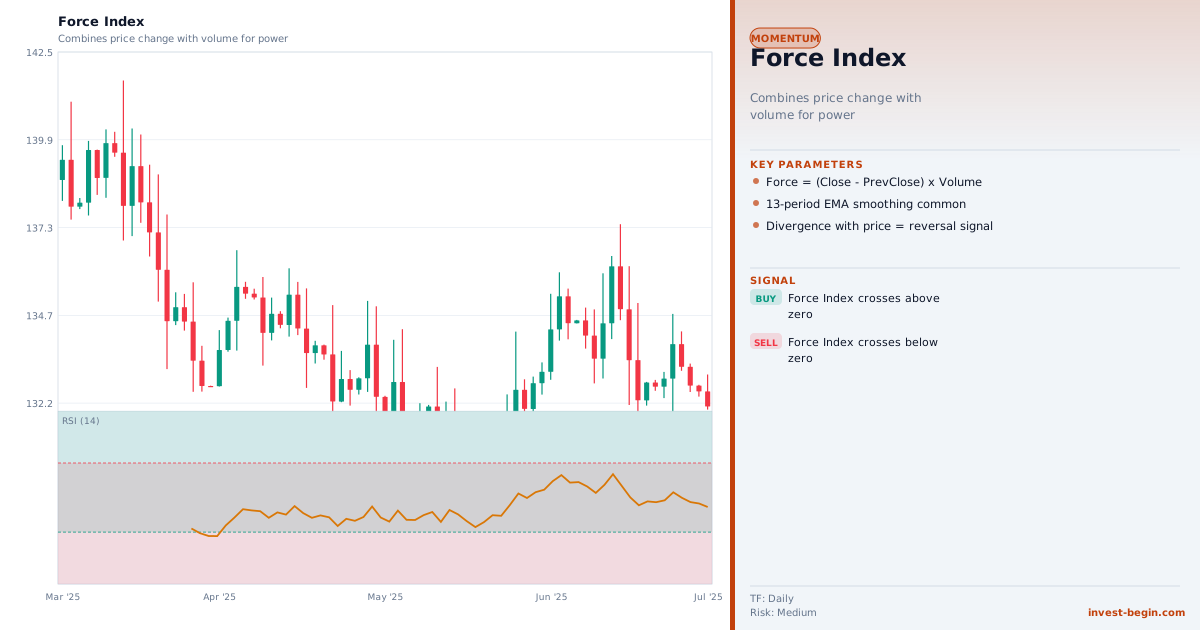
How It Works in auto-Trading

Automate It

auto-Trading computes the raw Force Index and both the 2-period and 13-period EMA versions simultaneously. The strategy builder supports 2-period zero-line dips as pullback entry signals, 13-period zero-line crossovers as trend change signals, and divergence detection against price. Force Index integrates natively with the Triple Screen system and Elder Ray indicators for a complete Dr. Elder trading framework.

Try Free →

Strategy Code

Pick a script below, copy it, and use it on your chart.

Pine Script (TradingView)

This is a TradingView Pine Script example for this indicator. Paste it into the TradingView Pine Editor, add it to your chart, and adjust inputs for your market and timeframe.

//@version=6
strategy("Force Index", overlay=true)
fastLen = input.int(20, "Fast Length")
slowLen = input.int(50, "Slow Length")
fast = ta.ema(close, fastLen)

Get full strategy code access

Enter your email address and full name to unlock this strategy code.

ThinkScript (thinkorswim)

This is a thinkorswim ThinkScript example for this indicator. Open thinkorswim, create a custom study, paste the script, and apply it to your chart.

input length = 13;
def fi = ForceIndex(length = length);
def buySignal = fi crosses above 0;
def sellSignal = fi crosses below 0;
AddOrder(OrderType.BUY_AUTO, buySignal, close, 1, Color.GREEN, Color.GREEN, "FI Buy");

Get full strategy code access

Enter your email address and full name to unlock this strategy code.

Ready to automate Force Index?

Join thousands of traders who use auto-Trading to execute this strategy automatically, 24/7.

Get Started Free →

All Strategies & Signals

Continue Learning

Trading Strategies

Trading Signals & Indicators