Overview
What is Relative Strength Index (RSI)?
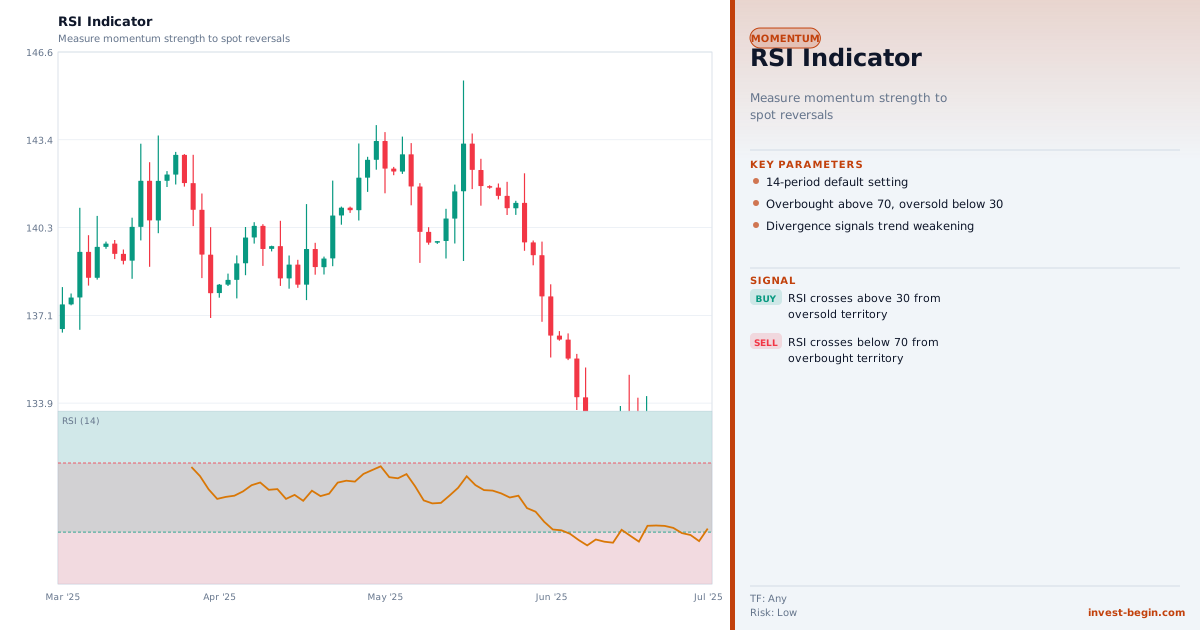
The Relative Strength Index (RSI) is a momentum oscillator developed by J. Welles Wilder Jr. and introduced in his 1978 book "New Concepts in Technical Trading Systems." It measures the speed and magnitude of recent price changes to evaluate overbought or oversold conditions on a scale of 0 to 100.
The standard calculation uses 14 periods: RSI = 100 − (100 ÷ (1 + RS)), where RS is the average of up-closes divided by the average of down-closes over 14 periods. A reading above 70 is traditionally considered overbought (potential reversal down), and below 30 is considered oversold (potential reversal up).
RSI divergence is one of the most powerful signals in technical analysis. Bullish divergence occurs when price makes a lower low but RSI makes a higher low — indicating waning bearish momentum and a potential reversal up. Bearish divergence is the opposite. These divergences often precede significant trend reversals and are most reliable on higher timeframes (4H, daily).
RSI can also be used in trending markets by adjusting the overbought/oversold thresholds: in uptrends, use 40 as oversold (instead of 30) and 80 as overbought; in downtrends, use 60 as overbought. This avoids the common mistake of shorting strong uptrends just because RSI reads above 70.