Overview
What is Elliott Wave Theory?
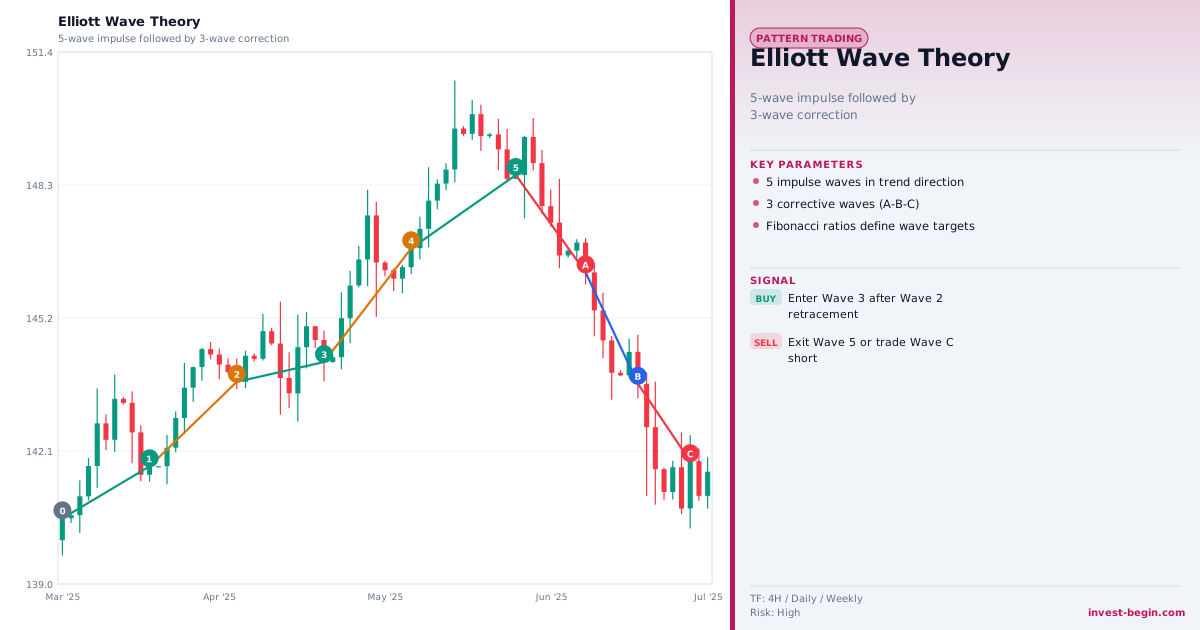
Elliott Wave Theory was developed by Ralph Nelson Elliott in the 1930s, who noticed that financial markets move in repetitive patterns that reflect the collective psychology of market participants. The core principle is that price moves in a five-wave impulse pattern in the direction of the main trend (waves 1-2-3-4-5), followed by a three-wave corrective pattern against the trend (waves A-B-C).
Within this basic structure, waves 1, 3, and 5 are "motive" waves in the direction of the trend, while waves 2 and 4 are "corrective" waves. Wave 3 is typically the longest and strongest, and never the shortest of waves 1, 3, and 5 — this is a key rule used for wave counting. Wave 4 rarely overlaps with the price range of Wave 1, providing an objective invalidation level.
Elliott Wave is fractal: each wave is composed of smaller waves of the same pattern, and each is a component of a larger wave of the same pattern. This fractal nature means Elliott Wave analysis applies equally from monthly charts down to 1-minute charts. Fibonacci ratios govern the relationships between waves — Wave 3 commonly extends to 1.618× the length of Wave 1, and corrections commonly retrace 38.2%–61.8% of the prior impulse.
The most actionable trade in Elliott Wave is entering Wave 3 after Wave 2's correction completes at a Fibonacci support level with a target at Wave 1's peak and beyond. The entry is defined, the stop is logical (below the Wave 1 high), and the target is calculated — making it a complete, rule-based setup.