Overview
What is Pairs Trading Strategy?
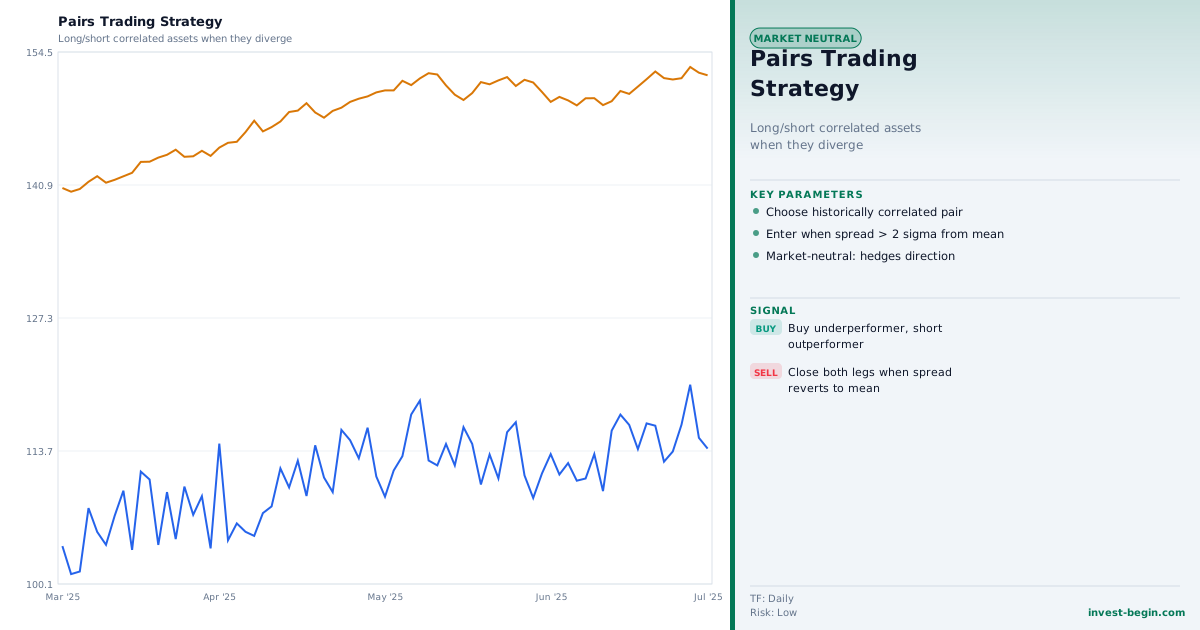
Pairs trading is a market-neutral strategy that simultaneously buys one asset and short-sells a closely related asset when their price ratio or spread diverges significantly from its historical mean. Because the position is hedged (long one, short the other), it is largely insulated from broad market moves — the trade profits purely from the relative movement between the two assets.
The strategy requires identifying two assets with a strong co-integration relationship — meaning their prices tend to move together over time due to shared fundamentals. Classic pairs include: Coca-Cola vs Pepsi, Gold vs Silver, two ETFs tracking the same index, or a stock vs its sector ETF. Statistical tests (Augmented Dickey-Fuller, Johansen) verify co-integration before deploying capital.
When the spread between the two assets exceeds a threshold (typically 2 standard deviations from the historical mean), the trader shorts the outperformer and buys the underperformer, betting on mean reversion of the spread. The position is closed when the spread reverts to the mean.
Risk management focuses on the spread — not the individual assets. A stop-loss is placed at a further standard deviation expansion (e.g., 3 SD) to protect against co-integration breakdown, which occurs when the fundamental relationship between the two assets changes permanently.