Overview
What is Stochastic RSI (StochRSI)?
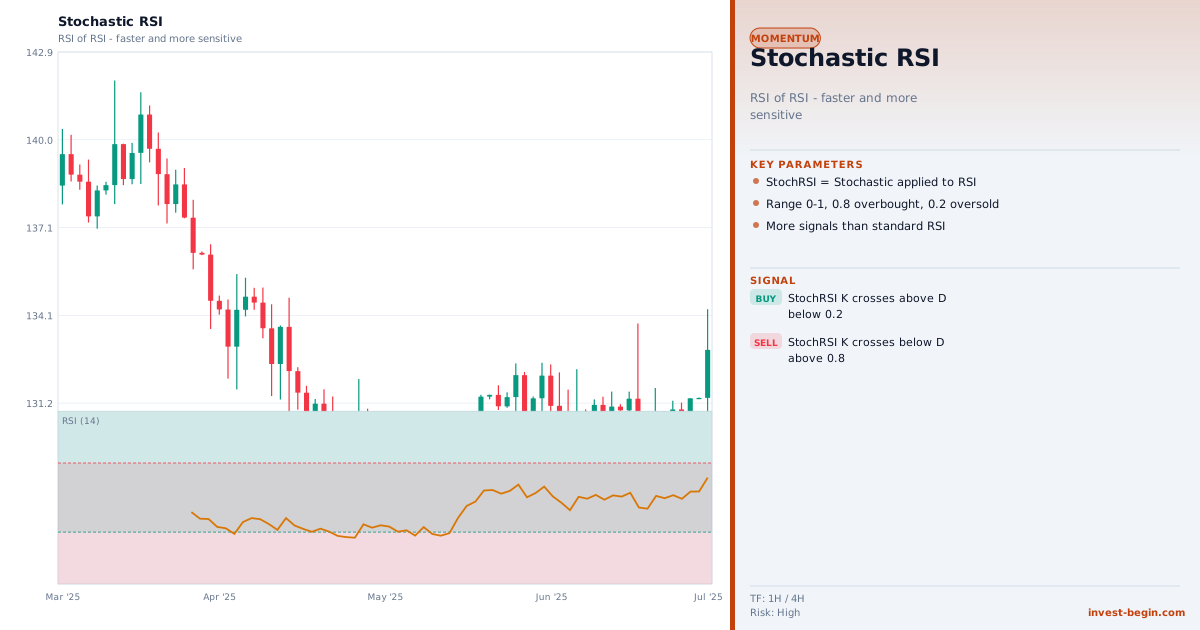
The Stochastic RSI (StochRSI) was developed by Tushar Chande and Stanley Kroll and introduced in their 1994 book "The New Technical Trader." Rather than applying the Stochastic formula to price (as the classic Stochastic Oscillator does), StochRSI applies it to RSI values — creating a double-filtered oscillator that is far more sensitive and faster-acting than either indicator alone.
Formula: StochRSI = (RSI − Lowest RSI over N periods) ÷ (Highest RSI over N periods − Lowest RSI over N periods)
The result oscillates between 0 and 1 (or 0 to 100 when scaled). Values above 0.80 indicate the RSI is near the top of its recent range (overbought); values below 0.20 indicate the RSI is near the bottom (oversold). A smoothed signal line (%D) is typically plotted alongside the raw StochRSI (%K) line, with %D crossovers providing the entry signals — exactly as in the standard Stochastic Oscillator.
The advantage of StochRSI over plain RSI is speed and sensitivity: RSI can remain in overbought territory for extended periods during strong trends without generating a buy signal, while StochRSI cycles through overbought and oversold more rapidly, identifying shorter-term entry and exit windows within the broader RSI move. This makes it especially useful for swing traders and intraday traders.
StochRSI is most powerful when used in combination with a trend filter — for example, taking only buy signals (StochRSI crossing above 0.20 from below) when price is above the 200 EMA, and only sell signals when price is below. In ranging markets, straightforward overbought/oversold reversals work well. In trending markets, use the crossing of the 0.50 midline as a trend-confirmation signal rather than the extreme levels.
Divergence between price and StochRSI is another high-probability signal: when price makes a new high but StochRSI fails to reach its own recent high, bearish divergence warns of exhaustion. This pattern is particularly reliable on the 4-hour and daily timeframes.